
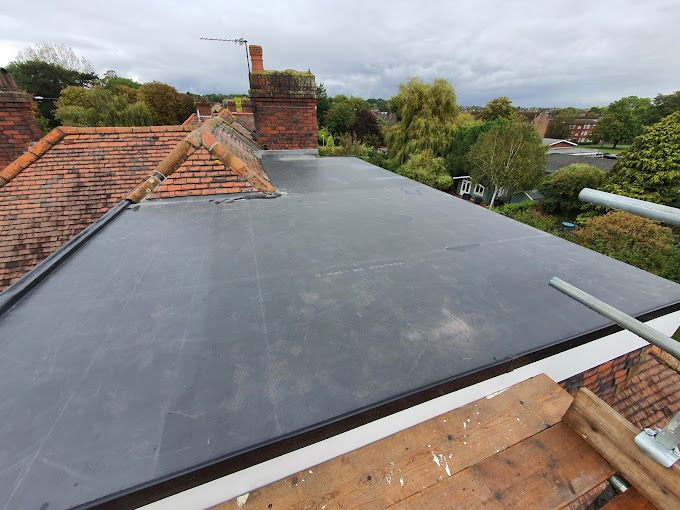
Water pools on a flat roof when it cannot reach an outlet freely. The cause may be leaves at the drain, inadequate roof falls, a high outlet lip or a deck that has deflected. Brief surface wetting after rain is different from persistent standing water. On a roof in Croydon, map where water remains before deciding which repair is needed.
Flat roofs still need a route to the drain
Most conventional flat roofs are designed with a slight slope. If that slope is inadequate or interrupted, water settles in the lowest area. A roof may look level from a window while differing enough in height to retain a substantial puddle.
IKO explains conventional single-ply falls using a design fall of 1:40 to achieve a finished fall of 1:80 after tolerances and deflection. A 1:80 slope drops 12.5mm per metre: over four metres that is 50mm. These figures explain the principle; the correct specification must follow the current guidance and assessed roof system, including any approved exceptions.
Start with the outlet and downstream pipe
Leaves, windblown debris and silt can reduce an outlet opening without closing it completely. Water then drains slowly after rainfall. An obstruction lower down the pipe can have the same effect even when the visible roof outlet looks clear.
Have the route checked with safe access, including any guard, hopper and discharge connection. If the pooling resolves after clearance, record that result and schedule maintenance around the site’s debris load. If water remains below a clear outlet, the outlet level or roof profile may be responsible. Repeating the clearance will not alter those levels.

Low spots can develop beneath the covering
Deflection of the deck or supporting structure can create a shallow basin. Compressed insulation, inappropriate later loads and poorly formed refurbishment layers may also affect levels. An outlet can become effectively too high when a new membrane or trim creates a raised lip around it.
Ask for a survey of the water path and the supporting build-up. A blanket coating can seal a surface but does not normally correct its geometry. Depending on the findings, work might involve a revised outlet detail, tapered insulation, firrings or structural repairs. The solution must preserve waterproofing heights and adequate drainage at every junction.
How long should standing water remain?
There is no universal countdown that proves every roof has failed. In a RICS-hosted Bauder technical discussion, ponding is described as a substantial accumulation above lap depth, caused by poor falls or deflection, remaining more than 48 hours after rainfall ends. The article is manufacturer-sponsored guidance, not a pass-or-fail warranty test.
Check the roof system’s own requirements and compare photographs after a genuinely dry interval. Repeated rain makes timing difficult. A dark stain may show where water has dried, while a reflection alone says little about depth. Report deepening or expanding pools, especially with an indoor leak or visible sagging.
The weight of water deserves attention
As an illustrative calculation, water 25mm deep across 10 square metres has a volume of 250 litres and a mass of approximately 250kg. This assumes an even depth and ordinary water density; a real puddle is usually uneven. It is not a structural capacity calculation for your roof.
The example shows why depth and area matter together. Do not deliberately flood a roof to find its low points or walk into standing water to measure it. Where substantial accumulation accompanies deformation, arrange professional assessment and keep people away from the affected area below if there are signs of structural distress.
Repair the cause and keep an overflow route
Clearing a blocked drain, altering a high outlet and correcting a sagging deck are different jobs. Ask the quotation to explain which cause was established and how the proposed work addresses it. A new drainage opening needs a designed, compatible waterproofing detail and a suitable discharge route.
Any overflow should remain unobstructed and should discharge where a blockage becomes apparent without directing water indoors. Blue roofs designed to hold water are a separate engineered system; ordinary accidental pooling is not a rainwater management feature. After repairs, retain photographs showing drainage performance during subsequent rainfall.
Summary
Persistent pooling points to an obstruction, a level problem or movement in the roof construction. Check the full drainage route and establish the geometry before choosing a surface repair.
If water keeps collecting on your Croydon flat roof, Excellent Building & Roofing can discuss an assessment of the outlets and roof condition. Use the flat roofing service page below to enquire.